



 Coming Soon
 Awards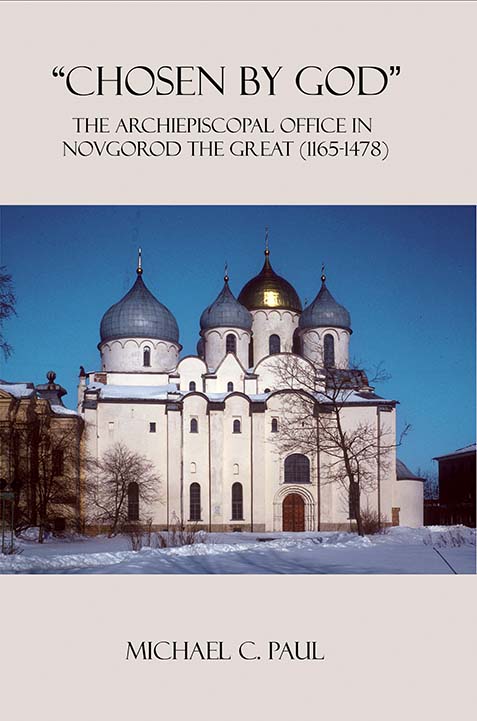
About the Author
Michael C. Paul earned his Ph.D. with an award of academic merit in Russian History from the University of Miami, Florida. His publications include numerous scholarly articles and entries to a number of encyclopedias, including The Supplement to the Modern Encyclopedia of Russian and Soviet History (SMERSH) and The Encyclopedia of Russian History.
Dr. Paul has taught at Towson University, The University of North Dakota, Indiana University Purdue University Indianapolis, and the University of Miami. He carried out archival research in St. Petersburg and Moscow in 2006 and 2007 as a Fulbright Senior Scholar. He currently works for the US government.
“CHOSEN BY GOD”: The Archiepiscopal Office in Novgorod the Great (1165-1478)
Michael C. PaulNew Academia Publishing, 2025
532 pages
ISBN 978-0-61543269-4 retail
 See an excerpt from the book.
For BULK ORDERS, order directly from New Academia Publishing.
Queries: orders@newacademia.com
About the Author
Michael C. Paul earned his Ph.D. with an award of academic merit in Russian History from the University of Miami, Florida. His publications include numerous scholarly articles and entries to a number of encyclopedias, including The Supplement to the Modern Encyclopedia of Russian and Soviet History (SMERSH) and The Encyclopedia of Russian History.
Dr. Paul has taught at Towson University, The University of North Dakota, Indiana University Purdue University Indianapolis, and the University of Miami. He carried out archival research in St. Petersburg and Moscow in 2006 and 2007 as a Fulbright Senior Scholar. He currently works for the US government.
“CHOSEN BY GOD”: The Archiepiscopal Office in Novgorod the Great (1165-1478)
Novgorod was one of medieval Russia’s key political, cultural, economic, and commercial centers; it has been said that its place in Russian culture is equal to that of Florence’s place in the Italian Renaissance. The archbishop of Novgorod was a key figure not only in the church, the preeminent institution in medieval Europe, but also in the political, judicial, social, and economic life of the city and of medieval Russia more broadly.
In spite of the importance of the archbishops, a focused study on the office and how its powers and roles developed over the course of the Middle Ages has not been undertaken. This study fills an important place in the historiography. It is a multifaceted undertaking which examines medieval Russian and northeastern European politics, religion, the cultural boundaries between Western and Eastern Christianity, economics and commerce, art, architecture and medieval culture, the place of the archbishops of Novgorod in these varied spheres. In so doing, it gives us a fuller picture of their dynamic office and their contributions to historical and cultural developments in Novgorod as well as the wider Russian medieval society.
The book provides a historical development not only of the office of archbishop, but through a discussion of that office, presents a fuller history of Novgorod and medieval Russia. By understanding how Novgorod and the church in Novgorod developed, it is possible to gain a fuller understanding of medieval Russia outside of Moscow, and gain a better appreciate how Novgorod declined while Moscow grew.
Praise
“This is an impressively massive piece of research and writing, aiming to uncover, analyze, and relate everything we know about the heads of the Novgorod eparchy down to the city-state’s full incorporation into Muscovy/Russia in 1478. We have nothing at all like this in English, and it will be very useful for scholars, students, and the curious public concerning what was medieval Russia’s greatest city. Every university and college library, where medieval or Russian history is taught should have this book.” —David Goldfrank, Professor Emeritus of Russian History, Georgetown University.